
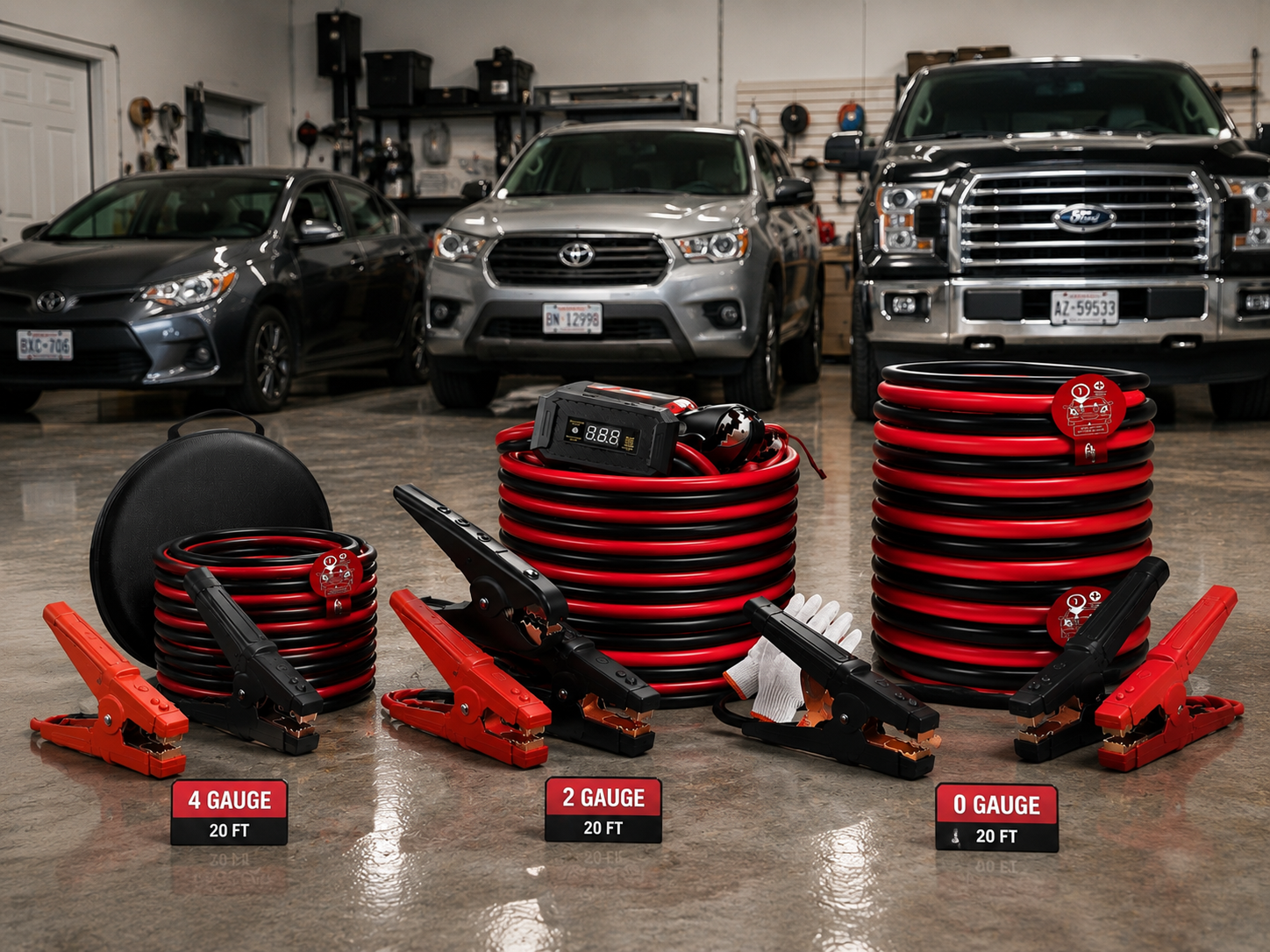
A dead car battery is stressful enough. Choosing the right jumper cables should not be.
If you are asking “What gauge jumper cables do I need?”, the simple answer is this:
Most everyday cars need 4 gauge jumper cables. Larger SUVs, pickup trucks, and V6/V8 vehicles are better served by 2 gauge jumper cables. Heavy-duty trucks, diesel engines, commercial vehicles, and long-distance jump starts are where 0 gauge jumper cables make the most sense.
Jumper cable gauge is based on American Wire Gauge, or AWG. In AWG sizing, a lower number means a thicker cable. That means 0 gauge is thicker than 2 gauge, and 2 gauge is thicker than 4 gauge. A thicker cable can move more starting current with less power loss, which matters when the battery is weak, the engine is large, or the weather is cold.

Quick Answer: Jumper Cable Gauge by Vehicle Type
Here is the fastest way to choose:
| Vehicle Type | Recommended Gauge | Best For |
|---|---|---|
| Compact car | 4 gauge | Basic emergency use |
| Sedan | 4 gauge | Everyday drivers |
| Small or midsize SUV | 4 gauge or 2 gauge | Safer choice: 2 gauge |
| Large SUV | 2 gauge | Stronger current flow |
| Pickup truck | 2 gauge | Better for larger batteries |
| Full-size truck | 2 gauge or 0 gauge | Heavy-duty use |
| Diesel truck | 0 gauge | High-cranking demand |
| Commercial vehicle / fleet | 0 gauge | Maximum reliability |
| Long 20–30 ft jump starts | 2 gauge or 0 gauge | Less power loss over distance |
TOPDC’s own jumper cable guidance follows the same general logic: 4 gauge is suited for standard sedans and midsized SUVs, 1–2 gauge is suited for heavy-duty trucks, SUVs, and large diesel engines, and lower gauge cables are recommended for longer 20 ft+ cables to reduce power loss.(TOPDC)
If you are unsure, choose the thicker cable. A thicker jumper cable is usually heavier and more expensive, but it gives you more starting power and more flexibility across different vehicles.
What Does Jumper Cable Gauge Mean?
“Gauge” refers to the thickness of the wire inside the jumper cable.
The most important rule is:
The lower the gauge number, the thicker the cable.
So the order from lighter-duty to heavier-duty is:
4 gauge → 2 gauge → 0 gauge
A thicker jumper cable helps in three ways:
-
It can carry more current.
-
It reduces voltage drop.
-
It performs better with larger engines and longer cable lengths.
This matters because jump starting is not the same as slowly charging a battery. When you turn the key or press the start button, the starter motor may need a large burst of current. If the cable is too thin, too long, or poorly connected, the dead vehicle may crank slowly or fail to start.
Why Cable Length Matters
Cable length is another major factor.
A longer cable is more convenient because you do not always get to park two vehicles nose-to-nose. In a driveway, parking lot, garage, or roadside emergency, a longer cable can make the difference between an easy jump and an impossible one.
But longer cables can also lose more power. That is why a 20 ft or 30 ft jumper cable should usually be paired with a thicker gauge.
For example:
| Cable Length | Better Gauge Choice |
|---|---|
| 12–16 ft | 4 gauge for cars, 2 gauge for larger vehicles |
| 20 ft | 4 gauge minimum, 2 gauge preferred for SUVs/trucks |
| 25 ft | 4 gauge for cars, 2 gauge for mixed use |
| 30 ft | 0 gauge for heavy-duty reliability |
If you want one set of cables that can handle most real-world situations, a 20 ft 2 gauge set is a strong middle choice. If you drive a heavy-duty truck or want maximum reach, a 0 gauge 30 ft set is the better long-term option.
4 Gauge Jumper Cables: Best for Most Everyday Cars
4 gauge jumper cables are the best choice for most standard drivers.
They are strong enough for most sedans, compact cars, crossovers, and small to midsize SUVs. They are also lighter, easier to store, and usually more affordable than heavier-duty cables.
Choose 4 gauge jumper cables if you drive:
-
A compact car
-
A sedan
-
A coupe
-
A small crossover
-
A midsize SUV
-
A daily commuter vehicle
For most people, a 4 gauge cable in the 16 ft to 25 ft range offers a good balance between performance, storage, and price. TOPDC currently carries 4 gauge jumper cables in multiple lengths, including 16 ft, 20 ft, and 25 ft options.(TOPDC)
When 4 Gauge Is Enough
4 gauge is enough when your vehicle has a normal-size gasoline engine and you mainly want emergency protection. It is a practical trunk item for family cars, daily drivers, and commuters.
When 4 Gauge May Not Be Enough
4 gauge may not be ideal if you drive a large truck, diesel vehicle, commercial vehicle, or frequently jump start vehicles in cold weather. It may also struggle more when the cable is very long or the battery is deeply discharged.
Best TOPDC fit:
Use a TOPDC 4 Gauge Jumper Cable if you want a practical, everyday emergency cable for cars and SUVs.
2 Gauge Jumper Cables: Best for SUVs, Trucks, and Stronger Starts
2 gauge jumper cables are the better choice for larger vehicles.
They are thicker than 4 gauge cables, which means they can carry more starting current with less resistance. That makes them a better fit for larger batteries, larger engines, and tougher roadside situations.
Choose 2 gauge jumper cables if you drive:
-
A midsize SUV
-
A large SUV
-
A pickup truck
-
A V6 or V8 vehicle
-
A work vehicle
-
A vehicle used in colder weather
A 2 gauge cable is also a smart choice if you want one set of jumper cables that can work across different vehicles in your household.
For example, if one family vehicle is a sedan and the other is an SUV or pickup, 2 gauge is usually the safer all-around choice.
2 Gauge vs 4 Gauge
Here is the difference in simple terms:
| Feature | 4 Gauge | 2 Gauge |
|---|---|---|
| Thickness | Medium-duty | Heavy-duty |
| Best for | Cars, sedans, small SUVs | SUVs, trucks, V6/V8 vehicles |
| Storage | Easier | Slightly bulkier |
| Starting power | Good | Stronger |
| Best buyer | Everyday driver | Driver who wants more reliability |
If you only drive a small car, 4 gauge is usually enough. But if you drive an SUV, truck, or mixed household vehicles, 2 gauge gives you a stronger safety margin.
TOPDC offers 2 gauge jumper cable options, including 16 ft and 20 ft heavy-duty cables, plus a 20 ft version with reverse polarity protection.(TOPDC)
Best TOPDC fit:
Use a TOPDC 2 Gauge Jumper Cable if you drive an SUV, pickup, or want one stronger cable set for multiple vehicle types.
0 Gauge Jumper Cables: Best for Heavy-Duty and Diesel Vehicles
0 gauge jumper cables are built for maximum starting power.
They are thicker, heavier, and stronger than 2 gauge and 4 gauge cables. This makes them the best option for serious roadside use, larger batteries, diesel engines, and long-reach jump starts.
Choose 0 gauge jumper cables if you drive:
-
A full-size truck
-
A diesel pickup
-
A work truck
-
A commercial vehicle
-
An RV
-
A vehicle used for towing
-
A fleet or service vehicle
0 gauge is also the right choice if you want a “buy once, keep it for years” cable set that can handle almost anything.
TOPDC’s 0 gauge jumper cables include 20 ft and 30 ft 1000A heavy-duty options, and the 30 ft version is positioned for trucks, SUVs, and challenging jump-start situations where extra reach matters.(TOPDC)
Is 0 Gauge Overkill?
For a small sedan, yes, 0 gauge is probably more than you need. It will still work when used correctly, but it is heavier, bulkier, and usually costs more.
For a diesel truck or full-size pickup, 0 gauge is not overkill. It is the right tool for the job.
0 Gauge vs 2 Gauge
| Feature | 2 Gauge | 0 Gauge |
|---|---|---|
| Best for | SUVs and trucks | Diesel and heavy-duty trucks |
| Cable weight | Heavy | Heavier |
| Power transfer | Strong | Maximum |
| Long cable performance | Good | Better |
| Best use case | Most larger vehicles | Professional or heavy-duty use |
Best TOPDC fit:
Use a TOPDC 0 Gauge 20 ft or 30 ft Jumper Cable if you drive a diesel truck, full-size truck, RV, commercial vehicle, or want maximum emergency reliability.
4 Gauge vs 2 Gauge vs 0 Gauge: Which One Should You Buy?
If you want the simplest answer, use this:
| Your Situation | Best Choice |
|---|---|
| I drive a normal car | 4 Gauge |
| I drive a sedan or compact SUV | 4 Gauge |
| I drive a midsize SUV | 4 Gauge minimum, 2 Gauge better |
| I drive a large SUV | 2 Gauge |
| I drive a pickup truck | 2 Gauge |
| I drive a full-size truck | 2 Gauge or 0 Gauge |
| I drive a diesel truck | 0 Gauge |
| I want one cable set for multiple vehicles | 2 Gauge |
| I want maximum power and reach | 0 Gauge |
| I want the easiest cable to store | 4 Gauge |
For most TOPDC shoppers, the decision comes down to this:
Choose 4 gauge for everyday cars. Choose 2 gauge for SUVs and trucks. Choose 0 gauge for diesel, heavy-duty, and long-reach emergency use.
Should You Always Buy the Thickest Jumper Cables?
Not always.
The thickest jumper cable is not automatically the best choice for every driver. A 0 gauge cable offers excellent power transfer, but it is also heavier and bulkier. If you only drive a compact car and want something easy to store in the trunk, a 4 gauge cable may be the smarter choice.
The best jumper cable is the one that matches your vehicle and real use case.
Ask yourself:
-
What vehicle do I drive?
-
Is it gasoline or diesel?
-
Do I live somewhere cold?
-
Do I need to help other vehicles too?
-
Do I need a longer cable?
-
Do I want basic emergency use or heavy-duty reliability?
If your answer is “I just need something for my sedan,” choose 4 gauge.
If your answer is “I drive an SUV or truck,” choose 2 gauge.
If your answer is “I drive a diesel, tow, work outdoors, or want maximum reach,” choose 0 gauge.
Other Features to Look for in Jumper Cables
Gauge matters, but it is not the only thing that matters.
Before buying jumper cables, also check these features:
1. Cable Length
Short cables are easier to store, but longer cables are easier to use in real emergencies. A 20 ft cable is a strong all-around choice. A 30 ft cable is better when vehicles cannot park close together.
2. Clamp Strength
Good clamps should grip battery terminals firmly. Weak clamps can slip, create poor contact, or make the jump start fail.
3. Insulation and Flexibility
A good jumper cable should remain flexible and easy to handle. TOPDC’s 0 gauge 30 ft cable, for example, highlights heavy-duty insulation and an extreme-weather operating range.(TOPDC)
4. Storage Bag
A storage bag keeps cables organized in the trunk, garage, or truck bed. It also prevents tangled cables and protects the clamps.
5. Safety Features
Some jumper cables include added safety features such as reverse polarity protection. This can be useful for drivers who want extra confidence when connecting clamps.
How to Use Jumper Cables Safely
Choosing the right gauge is important, but safe use is even more important.
Always check your vehicle owner’s manual first. Some vehicles have remote jump-start terminals, and some vehicles have specific procedures.
A basic safe jump-start process usually follows this order:
-
Turn off both vehicles.
-
Connect the red clamp to the positive terminal on the good battery.
-
Connect the other red clamp to the positive terminal on the dead battery.
-
Connect the black clamp to the negative terminal on the good battery.
-
Connect the final black clamp to a clean, unpainted metal ground point on the dead vehicle.
-
Start the working vehicle.
-
Wait a few minutes.
-
Try starting the dead vehicle.
-
Remove the clamps in reverse order.
Interstate Batteries recommends attaching the red clamps first, placing the final black clamp on a metal component rather than the dead battery, and removing the black clamps before the red clamps.
Do not jump start a battery if it is cracked, leaking, frozen, swollen, or giving off a strong rotten-egg smell. In those situations, stop and contact a professional.
Final Recommendation
So, what gauge jumper cables do you need?
For most drivers, the best answer is:
4 gauge for cars. 2 gauge for SUVs and trucks. 0 gauge for diesel and heavy-duty use.
If you only want a simple emergency cable for a sedan or small SUV, choose 4 gauge.
If you want stronger performance for a truck, SUV, or family garage, choose 2 gauge.
If you want maximum power, longer reach, and heavy-duty reliability, choose 0 gauge.
TOPDC carries jumper cables across all three major sizes, including 4 gauge, 2 gauge, and 0 gauge options for different vehicle needs.(TOPDC)
Shop TOPDC Jumper Cables and choose the right gauge before your next roadside emergency.
FAQ: Jumper Cable Gauge
What gauge jumper cables are best for a car?
For most standard cars, 4 gauge jumper cables are the best choice. They offer a good balance of power, storage, and price.
What gauge jumper cables do I need for an SUV?
For a small SUV, 4 gauge may be enough. For a midsize or large SUV, 2 gauge jumper cables are a better choice.
What gauge jumper cables do I need for a truck?
For most pickup trucks, choose 2 gauge jumper cables. For full-size trucks, diesel trucks, or work trucks, consider 0 gauge jumper cables.
Are 4 gauge jumper cables better than 6 gauge?
Yes, for most real-world car emergencies, 4 gauge is the better choice. It is thicker, stronger, and more reliable than 6 gauge.
Is 0 gauge better than 2 gauge?
0 gauge is thicker and more heavy-duty than 2 gauge. It is better for diesel engines, full-size trucks, commercial vehicles, and longer cable lengths.
Is 0 gauge overkill for a car?
For a compact car or sedan, 0 gauge is usually more than necessary. It can still work when used correctly, but 4 gauge is usually easier to store and more practical.
What length jumper cables should I buy?
A 16 ft cable is fine for basic use, but 20 ft is more practical for most drivers. If you drive a truck or want maximum flexibility, choose 25 ft or 30 ft cables with a thicker gauge.
Can jumper cables be too thick?
Thicker cables will not damage a vehicle just because they are thick. The bigger risk is incorrect connection, poor clamp contact, or using cables on a damaged battery. Always follow the correct jump-start procedure.
Share:
The Ultimate Guide to Jumper Cables: Choosing the Right Gauge and Using Them Safely
2 Gauge vs 4 Gauge Jumper Cables: Which One Do You Need?