
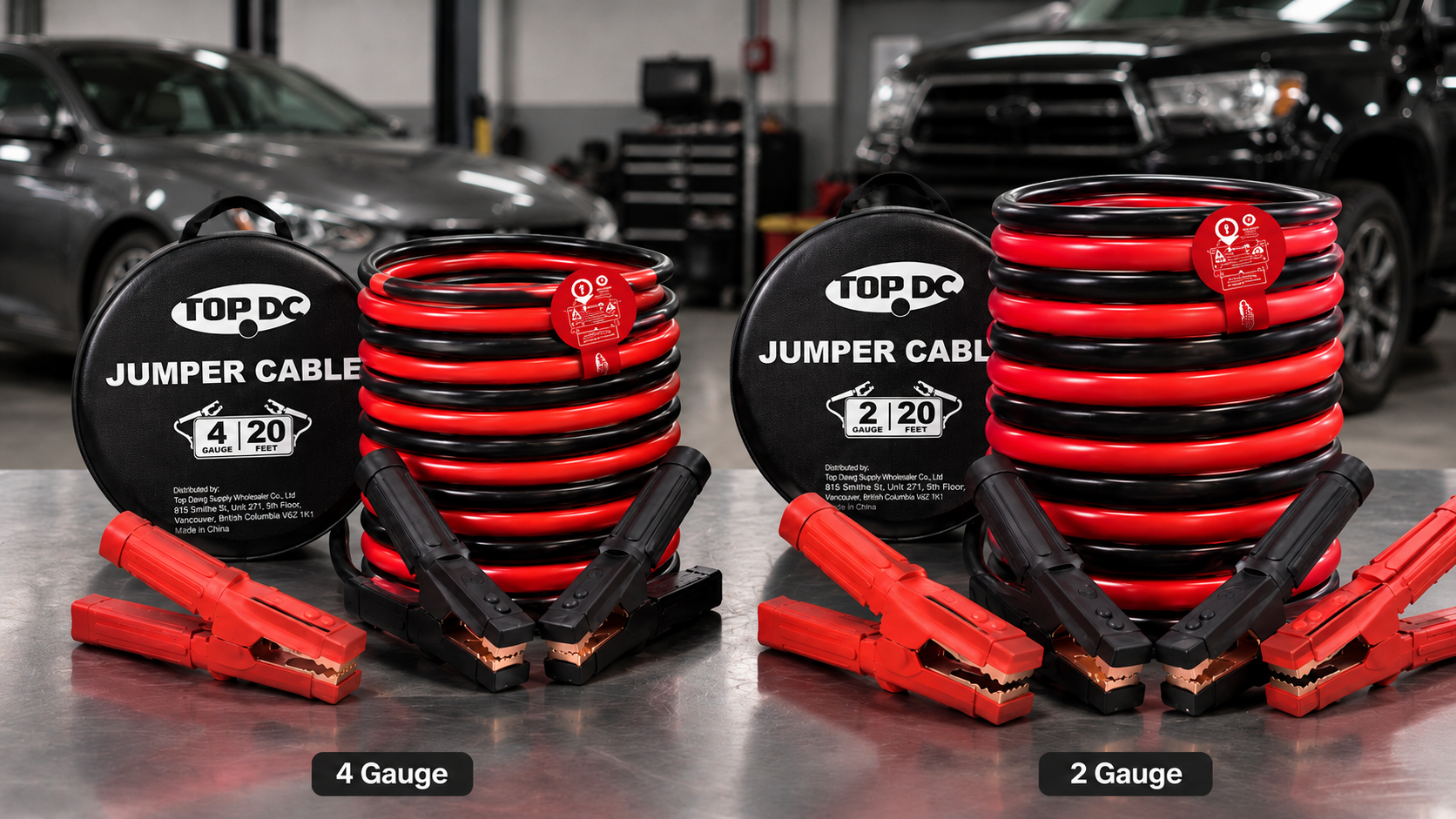
If you are comparing 2 gauge vs 4 gauge jumper cables, the main difference is cable thickness, power transfer, and the type of vehicle each cable is best suited for.
The simple answer is this:
4 gauge jumper cables are a great choice for most everyday cars, sedans, compact SUVs, and basic emergency use. 2 gauge jumper cables are better for larger SUVs, pickup trucks, V6/V8 vehicles, colder weather, and drivers who want stronger starting power.
In the American Wire Gauge system, a lower gauge number means a thicker wire. That means 2 gauge jumper cables are thicker than 4 gauge jumper cables. A thicker cable can carry more current with less resistance, which can help when jump starting larger engines or when the battery is very weak.
Quick Comparison: 2 Gauge vs 4 Gauge Jumper Cables
| Feature | 4 Gauge Jumper Cables | 2 Gauge Jumper Cables |
|---|---|---|
| Cable thickness | Medium-duty | Heavy-duty |
| Best for | Cars, sedans, compact SUVs | SUVs, pickup trucks, larger engines |
| Starting power | Good | Stronger |
| Cable weight | Lighter | Heavier |
| Storage | Easier to store | Slightly bulkier |
| Best cable length | 16 ft, 20 ft, 25 ft | 16 ft, 20 ft |
| Cold weather use | Good for normal cars | Better for larger engines |
| Best buyer | Everyday driver | Driver who wants extra reliability |
| Price level | Usually more affordable | Usually higher, but stronger |
For most standard cars, 4 gauge is enough.
For SUVs, trucks, and anyone who wants a stronger all-around emergency cable, 2 gauge is the better choice.
What Does Gauge Mean on Jumper Cables?
Gauge refers to the thickness of the wire inside the jumper cable.
The key rule is:
The lower the gauge number, the thicker the cable.
So when you compare 2 gauge vs 4 gauge:
2 gauge is thicker.
4 gauge is thinner.
This matters because jump starting a vehicle requires a strong burst of current. If the cable is too thin, too long, or poorly connected, the vehicle may crank slowly or fail to start.
A thicker cable helps reduce power loss, especially when:
-
The engine is larger
-
The battery is deeply discharged
-
The weather is cold
-
The cable is longer
-
The vehicle requires more starting current
That is why 2 gauge jumper cables are generally better for SUVs and trucks, while 4 gauge jumper cables are usually enough for normal passenger cars.
Are 2 Gauge Jumper Cables Better Than 4 Gauge?
In terms of power transfer, yes. 2 gauge jumper cables are better than 4 gauge jumper cables because they are thicker and can carry more current.
But that does not mean every driver needs 2 gauge.
The better question is:
Which cable is better for your vehicle?
If you drive a compact car, sedan, or small crossover, 4 gauge jumper cables are usually the smarter choice. They are easier to store, lighter to handle, and strong enough for most everyday emergencies.
If you drive a midsize SUV, large SUV, pickup truck, or V6/V8 vehicle, 2 gauge jumper cables are the better choice. They give you more starting power and more confidence when the battery is weak.
When Should You Choose 4 Gauge Jumper Cables?
Choose 4 gauge jumper cables if you drive a standard vehicle and want a reliable emergency cable for your trunk or garage.
4 gauge is best for:
-
Compact cars
-
Sedans
-
Coupes
-
Small crossovers
-
Small to midsize SUVs
-
Daily commuter vehicles
-
Basic roadside emergency use
A 4 gauge cable gives most drivers the right balance of performance, price, and convenience.
It is also easier to store than a heavier 2 gauge or 0 gauge cable. If your vehicle has limited trunk space, or you simply want a practical emergency cable that does not take up much room, 4 gauge is a strong choice.
TOPDC currently offers 4 gauge jumper cables in multiple lengths, including 16 ft, 20 ft, and 25 ft options. This gives everyday drivers flexibility depending on how much reach they want.
When Should You Choose 2 Gauge Jumper Cables?
Choose 2 gauge jumper cables if you drive a larger vehicle or want stronger jump-start performance.
2 gauge is best for:
-
Midsize SUVs
-
Large SUVs
-
Pickup trucks
-
V6 vehicles
-
V8 vehicles
-
Work vehicles
-
Family households with multiple vehicle types
-
Drivers in colder weather
-
Drivers who want stronger emergency reliability
A 2 gauge cable is thicker than a 4 gauge cable, so it is better suited for vehicles that require more starting power.
This is especially important if your household has more than one vehicle. For example, if you have a sedan and an SUV, 2 gauge is usually a better all-around cable than 4 gauge. It can still be used for the car, but it gives you more power for the SUV or truck.
TOPDC offers 2 gauge jumper cables in both 16 ft and 20 ft options, including a version with reverse polarity protection for added safety confidence.
2 Gauge vs 4 Gauge: Which Is Better for Cars?
For most cars, 4 gauge jumper cables are enough.
If you drive a compact car, sedan, or small crossover, a 4 gauge cable should handle most typical dead battery situations. It is practical, affordable, and easier to keep in the trunk.
However, 2 gauge can still be a good upgrade if:
-
You live in a cold area
-
Your battery is often weak
-
You want faster, stronger current transfer
-
You also need to help larger vehicles
-
You prefer buying a heavier-duty cable once
For a normal car, 2 gauge is not required, but it is not a bad choice. It is simply more cable than most car owners need.
Best choice for most cars: 4 gauge
Best upgrade choice: 2 gauge
2 Gauge vs 4 Gauge: Which Is Better for SUVs?
For SUVs, the answer depends on size.
For a compact SUV or small crossover, 4 gauge may be enough.
For a midsize SUV, large SUV, or V6/V8 SUV, 2 gauge is the better choice.
SUVs are often heavier and may have larger engines and batteries than sedans. That means they may need more starting power, especially if the battery is deeply discharged.
If you want one simple recommendation:
Choose 2 gauge jumper cables for SUVs.
The extra thickness gives you a better safety margin without going all the way up to 0 gauge.
2 Gauge vs 4 Gauge: Which Is Better for Trucks?
For pickup trucks, 2 gauge is usually better than 4 gauge.
Trucks often have larger engines, larger batteries, and higher starting demands. A 4 gauge cable may work in some cases, but 2 gauge is the safer and more reliable choice.
Choose 2 gauge if you drive:
-
A midsize pickup
-
A full-size pickup
-
A V6 truck
-
A V8 truck
-
A truck used for towing
-
A work truck
For diesel trucks, commercial vehicles, RVs, or very heavy-duty use, you may want to upgrade even further to 0 gauge jumper cables.
Does Jumper Cable Length Matter?
Yes. Cable length matters almost as much as gauge.
A longer jumper cable gives you more flexibility because two vehicles may not always be parked close together. In a garage, parking lot, driveway, or roadside situation, extra reach can make jump starting much easier.
But longer cables can also lose more power. That is why longer jumper cables should usually be paired with a thicker gauge.
Here is a simple way to think about it:
| Cable Length | 4 Gauge | 2 Gauge |
|---|---|---|
| 16 ft | Good for cars | Good for SUVs and trucks |
| 20 ft | Good for cars and small SUVs | Better all-around choice |
| 25 ft | Good for cars when more reach is needed | Stronger if available |
| 30 ft | Not ideal for heavy-duty use | Consider 0 gauge instead |
If you want a practical everyday setup, a 4 gauge 20 ft or 25 ft cable is a strong choice for cars.
If you want stronger performance for larger vehicles, a 2 gauge 20 ft cable is usually a better choice.
If you want maximum reach and heavy-duty power, consider a 0 gauge 30 ft jumper cable.
Should You Buy 2 Gauge Instead of 4 Gauge?
You should buy 2 gauge instead of 4 gauge if you want more power and more flexibility.
2 gauge is the better choice if:
-
You drive an SUV
-
You drive a pickup truck
-
You have a V6 or V8 engine
-
You want one cable for multiple vehicles
-
You live somewhere cold
-
You want stronger emergency performance
-
You do not mind a slightly heavier cable
4 gauge is the better choice if:
-
You drive a sedan or compact car
-
You want an affordable emergency cable
-
You want something easier to store
-
You do not need heavy-duty performance
-
You mainly want backup protection for occasional use
For most drivers, the decision is simple:
4 gauge is the practical everyday choice.
2 gauge is the stronger all-around choice.
What About 0 Gauge Jumper Cables?
If you are already comparing 2 gauge vs 4 gauge, you may also see 0 gauge jumper cables.
0 gauge is thicker and heavier-duty than both 2 gauge and 4 gauge. It is not necessary for most standard cars, but it is the best choice for heavy-duty needs.
Choose 0 gauge if you drive:
-
A diesel truck
-
A full-size truck
-
A commercial vehicle
-
An RV
-
A work vehicle
-
A vehicle used for towing
-
A fleet vehicle
0 gauge is also a great choice if you want a longer cable, such as a 30 ft jumper cable, without sacrificing too much power transfer.
TOPDC carries 0 gauge jumper cables in 20 ft and 30 ft options, including 1000A heavy-duty models designed for stronger roadside and garage battery boosting.
Final Recommendation: 2 Gauge or 4 Gauge?
Here is the easiest way to decide:
Choose 4 gauge jumper cables if you drive a car, sedan, compact SUV, or just want a reliable emergency cable for basic roadside use.
Choose 2 gauge jumper cables if you drive an SUV, pickup truck, V6/V8 vehicle, or want stronger jump-start performance.
Choose 0 gauge jumper cables if you drive a diesel truck, commercial vehicle, RV, or want maximum heavy-duty reliability.
For most everyday drivers, 4 gauge is enough.
For most SUV and truck owners, 2 gauge is the better investment.
For serious heavy-duty use, 0 gauge is the strongest choice.
Shop TOPDC Jumper Cables
TOPDC offers jumper cables for different vehicle needs, from everyday cars to trucks and heavy-duty roadside emergencies.
Recommended choices:
| Vehicle / Use Case | Recommended TOPDC Cable |
|---|---|
| Compact car or sedan | TOPDC 4 Gauge Jumper Cables |
| Small SUV or daily driver | TOPDC 4 Gauge 20 ft or 25 ft Jumper Cables |
| Midsize SUV | TOPDC 2 Gauge Jumper Cables |
| Pickup truck | TOPDC 2 Gauge 20 ft Jumper Cables |
| Extra safety confidence | TOPDC 2 Gauge Jumper Cables with Reverse Polarity Protection |
| Diesel truck or heavy-duty use | TOPDC 0 Gauge 20 ft or 30 ft Jumper Cables |
Whether you need a compact emergency cable for your car or a heavy-duty cable for your truck, choosing the right gauge can make jump starting easier, safer, and more reliable.
Shop TOPDC Jumper Cables and choose the right cable before your next battery emergency.
FAQ: 2 Gauge vs 4 Gauge Jumper Cables
Are 2 gauge jumper cables better than 4 gauge?
Yes, 2 gauge jumper cables are thicker and more heavy-duty than 4 gauge jumper cables. They are better for SUVs, trucks, larger engines, and stronger jump-start performance.
Is 4 gauge enough for a car?
Yes. For most compact cars, sedans, and small crossovers, 4 gauge jumper cables are enough for typical emergency use.
Is 2 gauge overkill for a car?
For a small car, 2 gauge may be more than necessary, but it is still a good upgrade if you want stronger performance or need one cable set for multiple vehicles.
What gauge jumper cables do I need for an SUV?
For compact SUVs, 4 gauge may work. For midsize and large SUVs, 2 gauge jumper cables are the better choice.
What gauge jumper cables do I need for a truck?
For most pickup trucks, choose 2 gauge jumper cables. For diesel trucks or heavy-duty trucks, consider 0 gauge jumper cables.
Is 2 gauge good for cold weather?
Yes. 2 gauge jumper cables are a better choice than 4 gauge for cold weather because thicker cables can deliver stronger current when batteries are under more stress.
Should I buy 2 gauge or 4 gauge jumper cables?
Buy 4 gauge if you drive a normal car and want basic emergency protection. Buy 2 gauge if you drive an SUV, truck, V6/V8 vehicle, or want a stronger all-around cable.
What is the best jumper cable gauge overall?
For most people, 2 gauge is the best all-around choice because it works well for cars, SUVs, and many trucks. For everyday cars only, 4 gauge is usually enough. For diesel or heavy-duty vehicles, 0 gauge is best.
Share:
What Gauge Jumper Cables Do I Need?
Best Jumper Cables for Trucks and SUVs: 2 Gauge vs 0 Gauge